
Why Structured Wiring Is One Of The Most Important First Steps When You Spec Your New Build Or Major Retrofit

Discover why structured wiring is one of the single most important
technology decisions in a new build or major retrofit and often overlooked — and what it costs when it’s done wrong or not at all.
There is a moment in almost every new build and retrofit project when the technology

conversation gets pushed to the end of the list. The architect has finalised the plans,
the builder has broken ground, and somewhere between the kitchen fittings and the
paint colours, someone says: “We’ll sort out the Wi-Fi and cameras etc once we move in.”
It is one of the most expensive decisions a homeowner or developer can make — and
most people only discover this when it is too late.
What Structured Wiring Actually Means
Structured wiring is not simply “running cables through walls.” It is the deliberate,
engineered design of a property’s entire technology backbone — the physical
infrastructure that carries data, power, audio, video, security signals, and or future automation
commands throughout a building. Done correctly, it is invisible, reliable, and built to
support whatever technology you install today and whatever you choose to add in ten

years.
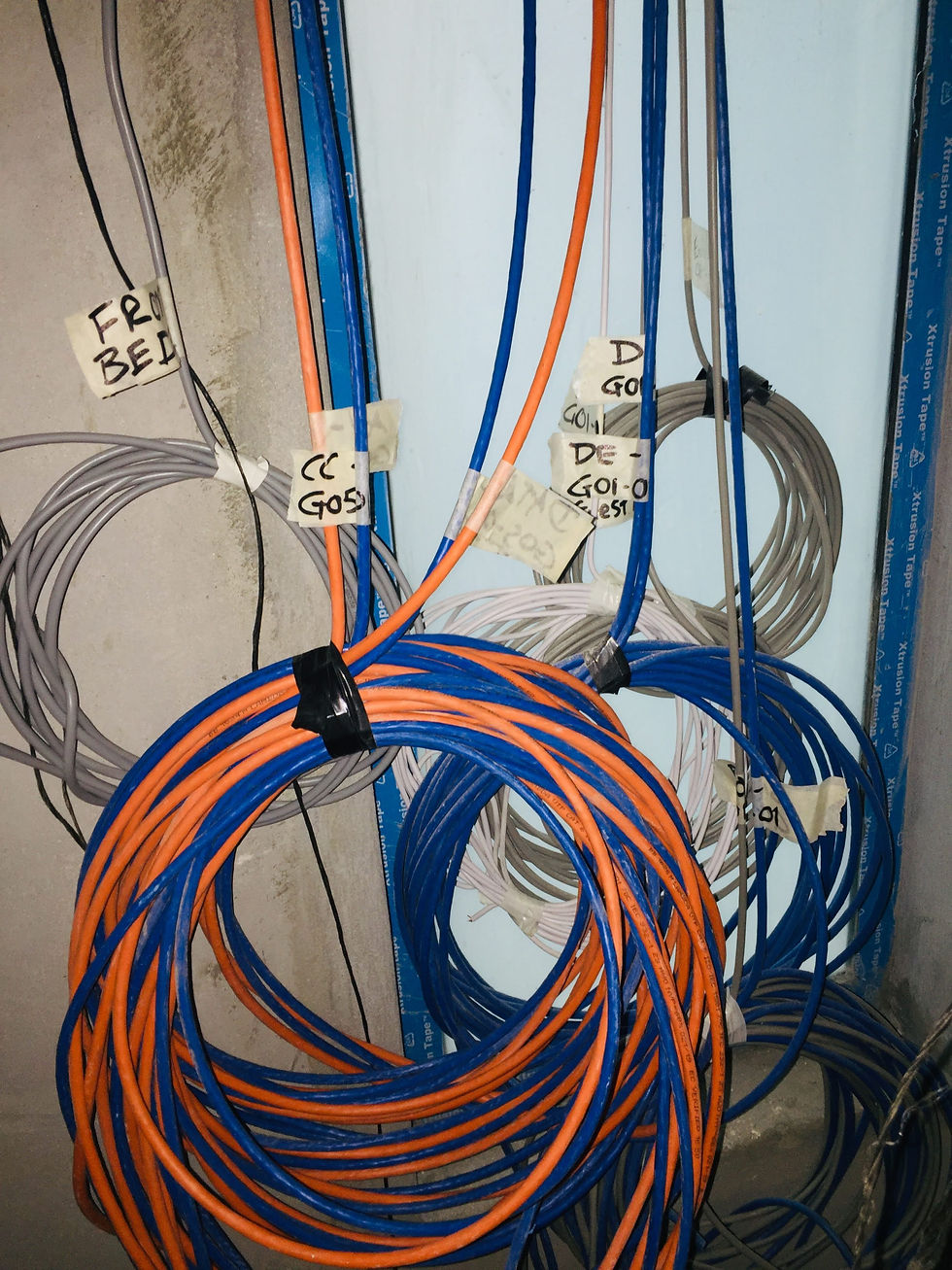
A properly structured installation includes a central distribution point (often called a
home rack or patch panel), from which all data, security, and AV cables radiate to every
room in the home. Every cable run is planned, labelled, and terminated to a
professional standard. The result is a system that can be reconfigured, upgraded, or
expanded without opening a single wall.
Done incorrectly — or not done at all — you get surface-run cables along skirting
boards, Wi-Fi routers plugged into random wall points, and a security system that
cannot integrate with anything else in the home. When you want to upgrade, you are
not adding to a system. You are replacing one.

The Real Cost of Getting It Wrong
The cost difference between structured and unstructured wiring at the time of
installation is often surprisingly small — particularly in a new build where walls are
open and cable runs are straightforward. The cost difference when you try to fix it later
is not small at all.
Retrofitting structured cabling into a completed home typically requires cutting into
walls, lifting floors, and repainting affected areas. In a single-storey home, a proper
retrofit can cost two to three times what the original installation would have cost. In a
multi-storey or complex property, the disruption and expense multiply further.
Beyond the direct cost, there is the opportunity cost: the smart home features you
cannot implement, the Wi-Fi performance you cannot achieve, and the security system
that cannot be expanded without compromise.
What Future-Ready Actually Looks Like
At Sanctum Smart Systems, every installation we design is built around the principle
of future-readiness. This means specifying cable categories that exceed current
requirements (Cat6A rather than Cat5e, for example), installing conduit in walls where
possible to allow future cable replacement, and designing the system around a central
rack that can accommodate new equipment as technology evolves.
It also means thinking beyond the obvious. An automation-ready home is not just one
with smart lights — it is one where the wiring infrastructure can support motorised
blinds, climate control, multi-room audio, electric vehicle charging, and any other
technology that becomes standard in the next decade, without a single wall being
opened.
Why Architects and Developers Should Care
For architects and developers, structured wiring is a specification decision that directly
affects the value and marketability of the finished product. Buyers in the Western Cape
market are increasingly sophisticated about technology infrastructure. A home that
can demonstrably support enterprise-grade connectivity, integrated security, and
smart automation commands a premium — and spends less time on the market.
More practically, specifying a technology integrator at the design stage rather than the
finishing stage eliminates the coordination problems that arise when cabling has to be
retrofitted around completed finishes. It also gives the architect and developer a single
point of accountability for the entire technology scope, rather than managing multiple
contractors with overlapping responsibilities.
The Sanctum Approach
We work with homeowners, architects, and developers from the earliest stages of a
project to design and implement technology infrastructure that is built to last. Our
scope covers structured cabling, enterprise Wi-Fi, CCTV and access control, smart

home automation, and distributed audio-visual systems — all designed as an
integrated whole, not as separate systems bolted together after the fact.
If you are planning a new build or a significant renovation in the Cape Town area, the
best time to have this conversation is now — before the walls and or ceilings close.
Book a free consultation with Sanctum Smart Systems at
www.sanctumsmartsystems.co.za or call 076 035 1651.

Comments